VOYAGES BEYOND
23 JUN 1757 · PLASSEY
Plassey stays loyal
Bengal, 23 June 1757. Half the Nawab's army is standing still under a bought general, waiting out the battle that will hand India to a trading company. This is the timeline where the general keeps his faith.
You are reading the timeline that almost was · notes marked THE RECORD are real history
23 JUN 1757 · THE CHARGE
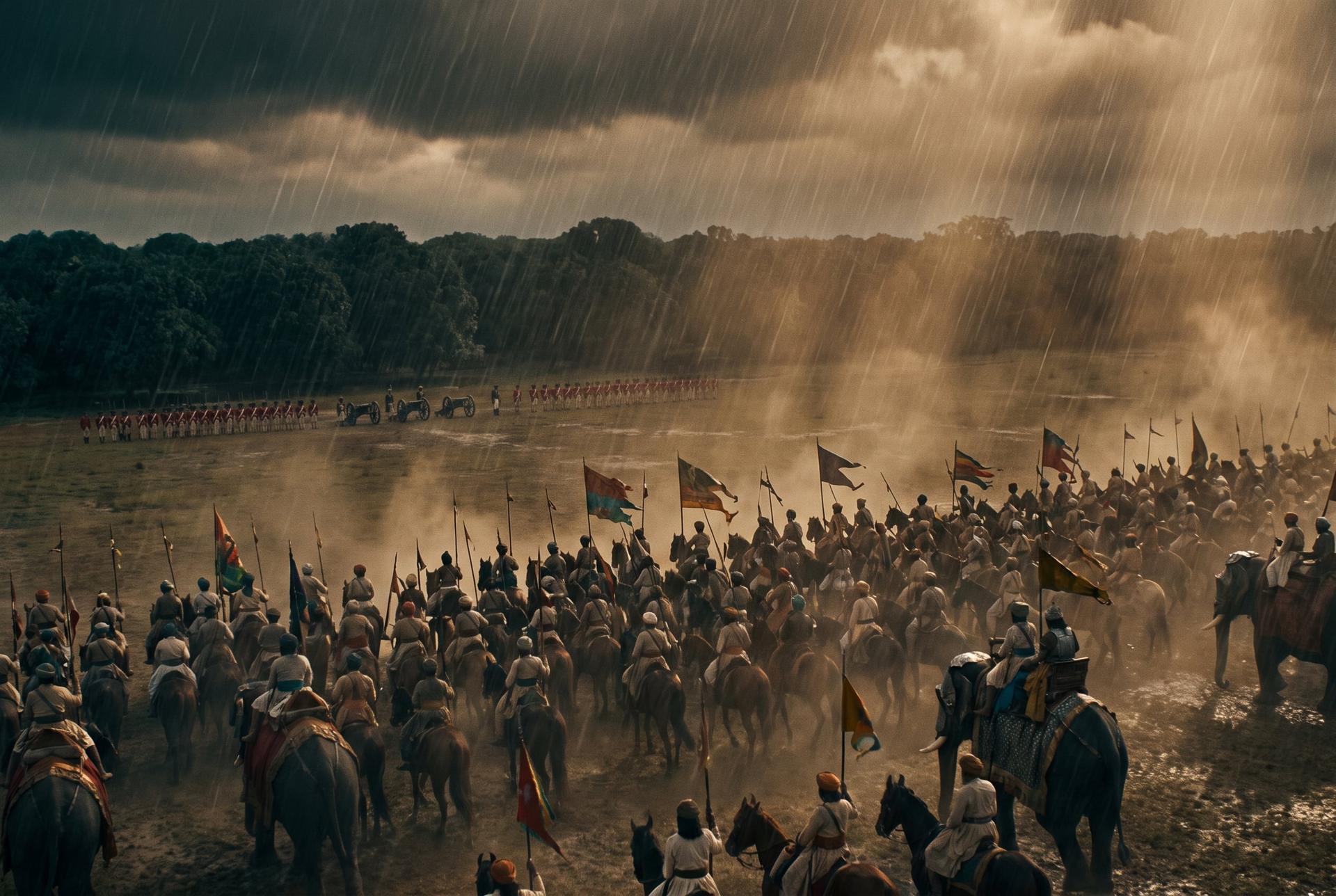
Bengal, 23 June 1757. Robert Clive of the East India Company stands in a mango grove at Plassey with about 3,000 men, facing the Nawab of Bengal, Siraj-ud-Daulah, with some 50,000, including 16,000 cavalry under Mir Jafar. The battle is fixed before it starts: Mir Jafar has secretly agreed to stand aside in exchange for the Nawab's throne. At noon a monsoon downpour drenches the field. Clive's gunners cover their powder with tarpaulins; the Nawab's do not. When the Nawab's best general charges the silent British guns believing them equally soaked, he is killed by grapeshot from dry cannon, Mir Jafar's third of the army never moves, and by evening Bengal belongs, in effect, to a joint-stock company.
In the timeline recorded here, the rain decides a different way. Mir Jafar sits his horse under the streaming sky, sixteen thousand sabers behind him, and weighs a written promise from foreign merchants against the sight of them: three thousand wet men in a grove, a day's ride from their ships. When the downpour stops the guns on both sides, he charges. Dry powder is an advantage against infantry at distance; against sixteen thousand horsemen arriving inside four minutes, it is a single volley. The grove holds for one hour. Clive dies at the second rally, sword drawn, forty paces from the tarpaulins that were to have made him a kingmaker.
Beat 1 of 8
The atlas keeps other pages near this one