DISCOVERIES & INVENTIONS
AUG 1684 · CAMBRIDGE
The apple misses Newton
London, January 1684. Three men in a coffee house set a wager that will send Edmond Halley riding to Cambridge, where a reclusive professor has the answer in a drawer. This is the timeline where the ride is never made.
You are reading the timeline that almost was · notes marked THE RECORD are real history
1684 · THE UNRIDDEN ROAD
London, January 1684. In a coffee house after a Royal Society meeting, Edmond Halley, Christopher Wren and Robert Hooke debate the great open question: would an inverse-square law of attraction produce the elliptical orbits the planets actually follow? Wren offers a prize of a forty-shilling book for a proof; no one collects it. In August, Halley rides to Cambridge to put the question to the Lucasian professor, Isaac Newton, a secretive alchemist who publishes almost nothing. Newton answers at once: an ellipse. He has calculated it, years ago; the paper is mislaid; he will redo it. The redoing becomes a book, the Principia, which Halley edits, corrects, and pays to print out of his own pocket. It founds modern physics.
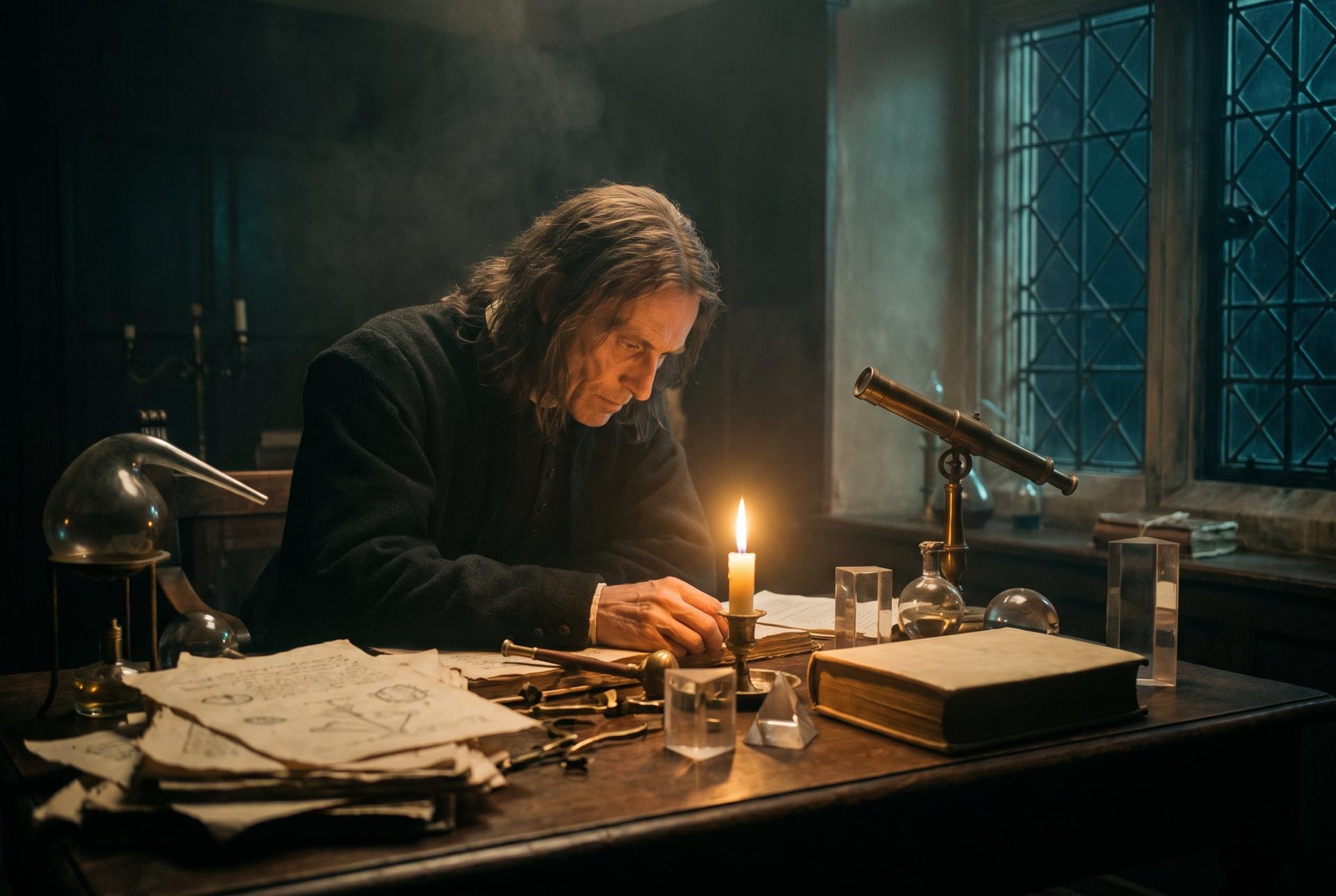
In the timeline recorded here, the ride is never made, and the reason is as small as history's hinges usually are. That spring Halley's father is found dead, and the son's year drowns in the estate: lawsuits, a stepmother, an inheritance in knots. The August road to Cambridge stays unridden, the wager gutters out as coffee-house wagers do, and the question returns to its shelf. In Trinity College the professor it was meant for goes on with what he considers his real work, the alchemy and the prophecies, his proof of the ellipse lying where it has lain for years, in a drawer, in a hand no one else has read. The notebook stays shut. The century does not know what it just failed to ask.
Beat 1 of 8
The atlas keeps other pages near this one