DISCOVERIES & INVENTIONS
1965 · THE PUNJAB
The seed in the dry year
In 1965 two failed monsoons and a rising population set India and Pakistan on course for the famine Paul Ehrlich would soon call unstoppable. Norman Borlaug's dwarf Mexican wheat reached them late and half dead, and was sown by hand as the two nations went to war. In our timeline that thin seed still came up and helped feed a subcontinent. This is the timeline where it comes up too thin to save.
You are reading the timeline that almost was · notes marked THE RECORD are real history
AUTUMN 1965
By 1965 the monsoon had failed across India, and a second failure was coming. The biologist Paul Ehrlich was already writing that the famine could not be stopped. The United States fed India from month to month, and President Johnson held the grain ships on a short tether. In Mexico, the agronomist Norman Borlaug had bred a dwarf wheat from Japanese Norin 10 genes. Its straw was short and stiff, able to carry a heavy head without falling over. About 450 tonnes of that seed were shipped to the subcontinent, 250 to Pakistan and 200 to India. The cargo was held in Mexican customs, trucked to Los Angeles around the Watts riots, and reached the fields damaged and half asleep. As it arrived, India and Pakistan went to war.
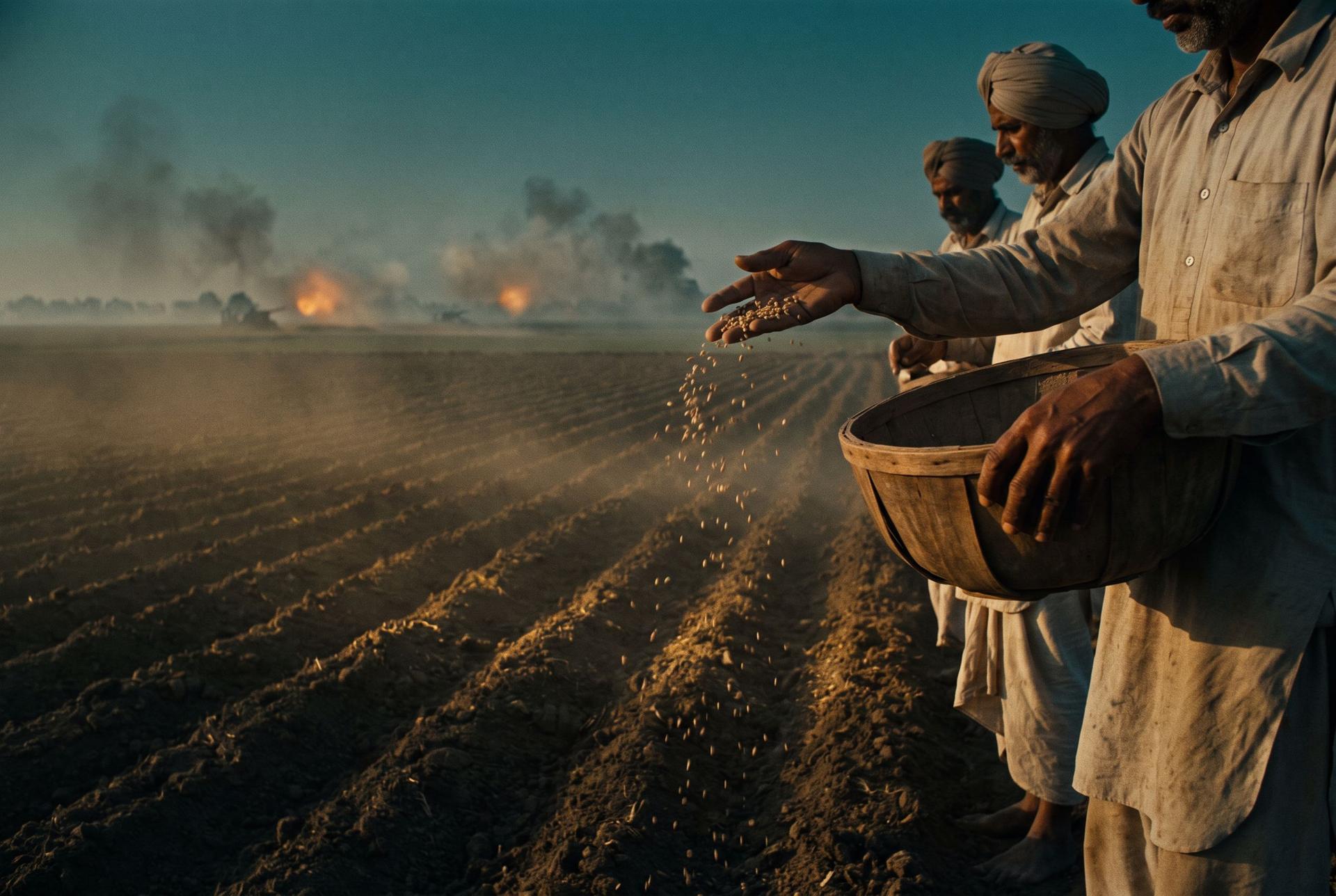
In the timeline recorded here, the crates wait a week longer in a hot Mexican shed, and most of the seed never wakes. The farmers of the Punjab sow it anyway, thick and by hand, in the cool of November. Beyond the last furrow the night sky flickers with artillery. Every short straw that rises must carry a heavy head of grain, or the dry year wins.
Beat 1 of 8
The atlas keeps other pages near this one